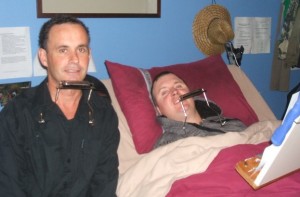
A free course designed for people with quadriplegia who cannot use their hands. The harmonica is played through a neck-mounted rack, which makes it one of the few instruments accessible to high-level injuries — and one of the most effective respiratory exercises available.
— Jeremy Olson, on the standard respiratory exercise prescribed after high-level SCI
A few years ago I realised something that could change the lives of many people for the better. Paralysis after high-level spinal cord injury is often associated with weakness of the diaphragm and intercostal muscles — the same muscles that drive the harmonica. That weakness creates a dangerous susceptibility to lung infections, which remain one of the leading causes of death in this population.
The harmonica is one of the very few musical instruments that can be played entirely hands-free, using a neck-mounted holder. It requires no prior musical knowledge to get started. The holes are numbered. You can play sitting, reclining, or lying flat. Unlike blowing through a straw, it is actually enjoyable — and the more enjoyable the exercise, the more often you do it.
With the help of expert harmonica players — including Ben Hewlett — and several people living with quadriplegia, I built a beginner course that has been endorsed by SCI associations in Australia, Canada, New Zealand, South Africa, and the USA.
Strengthening the breath and living longer is a by-product of having a good old-fashioned blast on the harp.
Incentive spirometry, balloon inflation, breathing through a straw — the standard respiratory exercises after high-level SCI are boring, repetitive, and easy to abandon. Adherence is the real problem, not effectiveness. The harmonica solves the adherence problem by being musical.
Respiratory complications remain the leading cause of death in people with cervical spinal cord injury. Weakness of the diaphragm, intercostal, and abdominal muscles reduces vital capacity, impairs the cough reflex, and allows secretions to pool — creating the conditions for pneumonia and atelectasis.
Playing the harmonica requires sustained, controlled inhalation (draw notes) and exhalation (blow notes), alternating in musical rhythm. Every phrase is a micro-workout for the same muscles that physiotherapists want you to train. A typical three-minute song delivers several hundred coordinated breath cycles of varying depth and force — far more engaging than counting repetitions on a spirometer.
Harmonica-based respiratory training has been studied in people with COPD and, more recently, in SCI. While the evidence base for SCI specifically is still developing, the theoretical rationale is strong: the instrument exercises exactly the muscles that need exercising, it creates inspiratory resistance through the reed plate, and it produces immediate acoustic feedback that rewards good breath control. Programmes such as Harmonicas for Health have brought this approach into pulmonary rehabilitation settings worldwide.
This programme is not a replacement for respiratory physiotherapy. If you have a tracheostomy, phrenic nerve pacemaker, or a ventilator dependency that affects your ability to generate airflow at the mouth, speak with your respiratory team before starting.
A spirometer gives you a number. A harmonica gives you a note, a phrase, a song. When the exercise produces music that you and the people around you want to hear, compliance stops being the bottleneck.
The instrument also provides natural progression. A beginner trains shallow, controlled breaths on simple melodies; an intermediate player draws deeper, holds notes longer, and bends pitch — which requires even finer breath control. The exercise scales with your lungs.
The entire programme requires two pieces of equipment. Total cost is around $30–50. A carer or family member will need to help you get set up the first few times — after that, most players can stay set up for the duration of a practice session without further assistance.
Standard harmonica technique assumes you are cupping the instrument with both hands — controlling tone, vibrato, and wah effects with hand movement. Hands-free players use different tools to achieve the same musical results. None of these adaptations compromises the core sound of the harp.
You will get better much quicker if you build good practice habits early. The harmonica rewards focused, mindful practice far more than mechanical repetition. This section gives you the framework I use and recommend — adapted from years of teaching and from working with players who have gone from absolute beginner to performance-ready.
Sometimes you are going to feel untalented and incompetent — when nothing sounds right and you want to give up. Don't be disheartened. No matter how good you get, you will always find something else to frustrate and then delight you. This is when you push through, and when the rewards arrive that the few have earned.
There is a stage every learner reaches where the notes come out clean, the breath is steady, the holes are in the right place — and it still does not sound like music. This is real. It has a name. It is the gap between producing notes and playing phrases, and it is where most adult learners stall. The two exercises below are designed to walk you across it. Neither requires hand function. Both work as well in bed as at a table.
The single most important thing the harmonica does is hold a conversation. Blues itself is built on conversation — twelve bars of call and answer, repeated for as long as anyone has anything to say. Before you can have that conversation with a band, you need to have it with one other voice. That is what these exercises are for.
Each track below contains a phrase I play, followed by an exact stretch of silence for you to fill. Copy what I played as closely as you can. You will get it wrong at first. That is the point — the gap between what you heard and what came out is the lesson. Listen to the original again. Try once more. Move on when you have it.
Work through the five exercises in order. Spend a week on each if you need to. There is no rush, and there is no test at the end — only a working ear, which is the prize.
Every harmonica player who ever sounded good learned by stealing phrases from someone they admired. There is no shortcut and no shame in it. The reason this works is that you skip the hardest part — inventing musical phrases — and instead practise deploying them. Invention comes later, naturally, once your ear is full of good material.
Below are ten phrases I have transcribed from the masters and recorded for you to learn. Each is short. Each was written by someone whose name is on the recording. Each will sound like music every time you play it, because it already is music.
Spend one week on each phrase. Ten phrases over ten weeks gives you a working vocabulary — enough to start dropping them into a slow blues and have something real to say.
One line per phrase, in a notebook, a phone note, a Google doc — the format does not matter. Write down what player it came from, when you learned it, and what feeling it carries for you. After ten phrases this becomes a personal artefact that proves you are a player. After fifty it is a record of how your ear has grown.
The act of naming each phrase — "the falling Sonny Boy phrase," "the long Adam Gussow bend" — is what turns a row of notes into a musical object you own.
Each video below walks you through one part of the hands-free method. Start with video one and work through them in order. All videos are hosted on YouTube — play them at full screen, rewind as often as you need, and try each step immediately with your own harp.
The programme has been promoted through the newsletters and member channels of spinal cord injury associations in Australia, Canada, New Zealand, South Africa, and the United States. It has been built with direct input from people living with quadriplegia and from the professional harmonica teacher Ben Hewlett.
Listening is part of practice. Spending time with the players who define the instrument trains your ear, gives you a vocabulary of phrases to absorb, and reminds you what is possible. The teachers below are the ones I recommend most often — Adam Gussow above all, who is essentially the founding father of online harmonica instruction.
When you find a phrase you love, slow it down and try to copy it. This is how every harmonica player who has ever lived has learned the instrument — by listening to a master and stealing what they did. There is no shortcut, and there is no shame in it.
The course is free. The equipment costs around $40. The first clean note is somewhere between five minutes and a few days away. Get in touch if you would like help getting started, want to share your progress, or have questions about the programme.